Sector-Specific Conditions
(ESRS 2.40 ii, ESRS 2.42 c)
We supply products to a wide range of industries. Our main customers are in the chemical, construction, automotive, semiconductor and photovoltaic sectors.
Moderate growth in global chemical production
In 2025, the chemical industry saw overall moderate growth worldwide but it continues to be impacted by strong regional differences. According to the German Chemical Industry Association (VCI), global growth rates are especially distorted by strong growth in China while other regions experience weaker rates. In China, industrial policy and strong capacity expansion led to high production growth but overcapacity and intense price competition exerted pressure on margins. In the USA, chemical production increased only slightly; trade conflicts and tariffs made imports more expensive, impeding growth. In the European Union, structural problems and US tariff policy impacted competitiveness and investment activities. The anticipated turnaround did not materialize. According to the VCI, global chemical production grew by 3.5 percent in 2025. Growth amounted to 7.5 percent in China year over year, but was only 1.5 percent in the USA. Production in Europe declined by 2.0 percent.
The VCI reported that the German chemical and pharmaceutical industries remained in a difficult position in 2025. Compared with the previous year, production, prices and sales continued to decrease. Average capacity utilization in the chemical sector was well below the profitability threshold. Overall, there was a slight decline of -0.5 percent in production in Germany’s chemical and pharmaceutical sectors, but the decrease of 2.5 percent in chemical production was only partially compensated for by growth in the pharmaceutical industry. Total sales in these sectors eased by around 1 percent in 2025 to €220 billion. The German chemical industry suffered, among other things, from lower investment spending in construction and is benefiting less and less from growth in other regions. As a result, the first plants were permanently shut down. The number of employees in Germany’s chemical and pharmaceutical industries decreased by 0.5 percent in 2025. Reports of more planned job cutbacks are growing.
Construction industry worldwide still weak
According to an analysis by the market research institute B+L Marktdaten GmbH, the global construction industry experienced slight growth in 2025. Preliminary figures show that construction volume (buildings and civil engineering works) worldwide rose by 0.2 percent year over year and totaled some US$8.90 trillion in 2025 (2024: US$8.88 trillion). Public infrastructure programs, urbanization in emerging markets and investment spending in energy and industry projects provided positive impetus. Construction of new buildings declined slightly, whereas the modernization and renovation market showed a moderate recovery.
Residential construction was weaker than the other segments in 2025, easing 1.9 percent. Regional differences were visible – as in the previous year. Asia, western Europe, eastern Europe and North America saw a downturn, though it was more modest in each case than in the previous year. Residential construction markets in South America recovered, undergoing slight growth. The Middle East/Africa region saw the largest increase in construction volume in 2025.
% |
|
2025 |
|||
|---|---|---|---|---|---|
|
|
|
|||
Worldwide |
|
-1.9 |
|||
Asia |
|
-2.5 |
|||
Western Europe |
|
-2.4 |
|||
North America |
|
-2.9 |
|||
Middle East/Africa |
|
3.4 |
|||
Eastern Europe |
|
-0.3 |
|||
South America |
|
1.5 |
|||
|
|||||
International automotive markets grow
According to the Association of the German Automotive Industry (VDA), global car markets did indeed record growth in 2025 compared with the previous year, albeit at different rates. New vehicle registrations in the European market were, overall, up year over year but still lagged well behind the pre-crisis level seen in 2019. The latter end of 2025 saw a market trend emerge specifically in new vehicle registrations for plug-in hybrids (PHEVs) since regulatory changes have been set for 2026. Over the course of the year, the USA recorded an increase in new registrations in the light vehicle (LV) category despite sales in the fourth quarter slowing significantly – primarily due to the end of subsidies for electric vehicles owing to the Inflation Reduction Act (IRA). China again recorded the biggest growth spurt in 2025. The Japanese market recovered as against the previous year and reported growth. In India, tax relief significantly stimulated market growth. The number of new registrations in Germany rose only slightly year over year, with the electric car market seeing the highest growth. The VDA reports that Germany has established itself as the world’s second-largest production base for electric cars. In the reporting period, a total of around 4.15 million cars were delivered from German factories to customers across the globe, up by 2 percent on 2024.
Strong sales growth continues in the semiconductor industry
2025 was another year during which the global semiconductor market performed positively. According to a forecast released by the World Semiconductor Trade Statistics Organisation (WSTS), the market grew by 22.5 percent compared with the previous year and is likely to reach a volume of some US$772 billion. Developments within the industry vary considerably from segment to segment. Growth was driven first and foremost by high demand for chips for AI applications, which data centers rely on. The dominant market positions enjoyed by a handful of companies in this growth segment shaped the price trend. 2025 saw the demand for silicon wafer deliveries, which serve as a key market indicator, start to recover. The recovery was driven by investment spending in AI and advanced production technologies. The Semiconductor Equipment and Materials International (SEMI) industry association estimates that growth in silicon wafer deliveries in the first nine months of the year was primarily driven by demand for 300-mm wafers for advanced logic chips used for complex computer operations, as well as by cloud infrastructure and memory chips. Growth of 3 percent is expected overall in this area compared with the previous year. Market conditions remained largely stable in the second half of 2025 as well – despite political tensions and uncertainty surrounding customs regulations.
Raw-material prices down slightly
(ESRS 2.42 a, c)
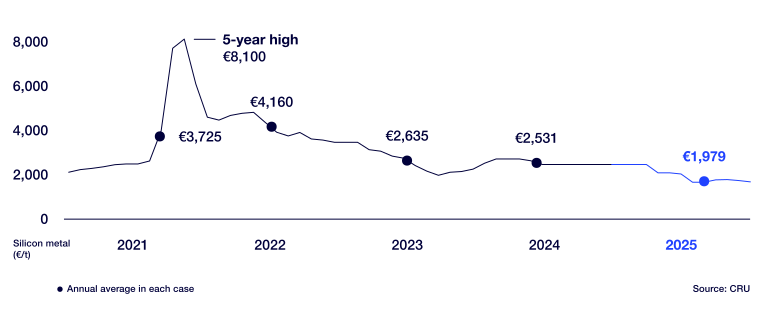
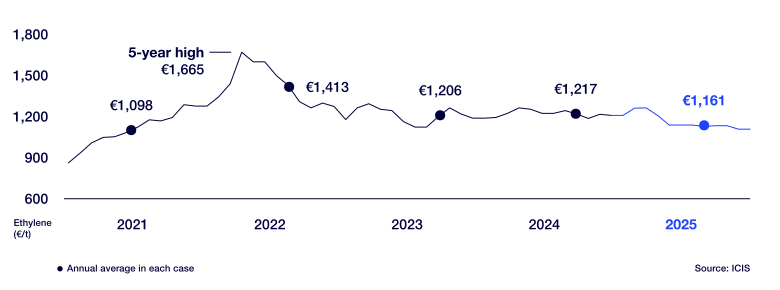
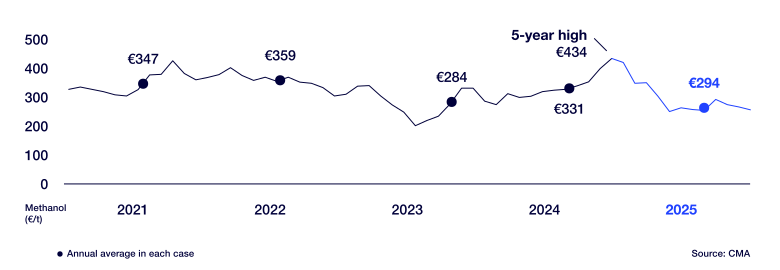
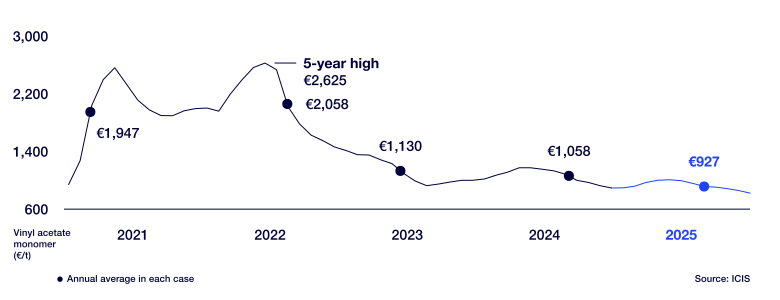
Following the sideways price trends in 2024 for some of WACKER’s key raw materials, prices for many of these materials declined slightly in 2025. Generally, most markets experienced weak demand coupled with excess supply.
Market prices for metallurgical-grade silicon, one of WACKER’s key raw materials, fell further outside of the USA due to weak demand. WACKER’s main petrochemical raw materials (vinyl acetate, acetic acid and ethylene), too, saw prices continue to decrease slightly due to weak demand. This trend was also observed for a large number of other raw materials. After rising sharply in 2024 following a temporary supply shortage, European prices for methanol continued their ongoing downward trend.
Market-price trends for WACKER’s key raw materials in Europe
Silicon metal
(€/t)
Ethylene
(€/t)
Methanol
(€/t)
Vinyl acetate monomer
(€/t)
Energy prices ease slightly
(ESRS 2.42 a, c)
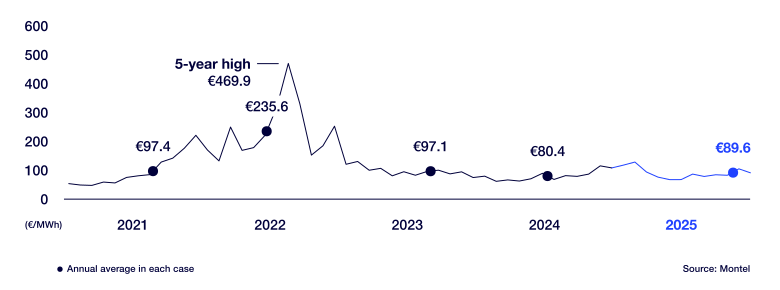
2025 was another year in which prices for coal and crude oil declined slightly. Following an easing of the natural-gas supply due to globally mild winters in 2022 – 2023 and 2023 – 2024, natural-gas prices in Europe became significantly more expensive once again in winter 2024 – 2025 and did not fall to 2024 levels until the second half of the year. As a result, moreover, wholesale electricity prices in 2025, while volatile, settled at around their prior-year level, which was about twice as high as in 2019 and 2020. The higher natural-gas prices were countered by the price-reducing effects of an ongoing increase in electricity generation from wind and photovoltaic systems and the continued decrease in industrial energy consumption amid the economic slowdown. In non-liberalized markets, such as in Asia, electricity prices remained predominantly stable or increased only slightly.
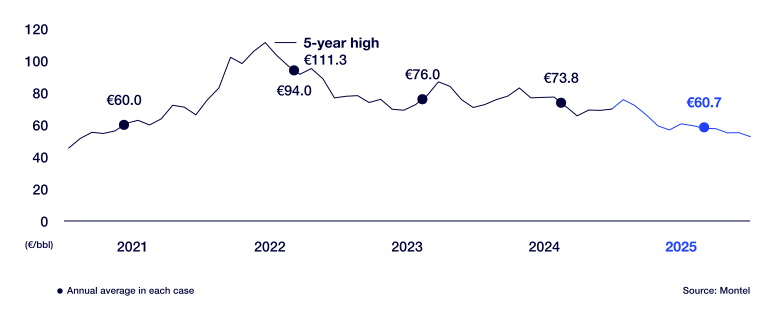
The price of coal saw a slight decline with supply still strong but weak demand persisting, due to a sound supply of natural gas on one side and the weak economic environment on the other. Crude-oil prices saw high levels of volatility but were down in general over the course of the year. In April, oil prices fell significantly when US tariffs were announced and tensions in the Middle East triggered considerable nervous jumps in prices. However, both were clearly subdued by the persistent weakness of demand in the economy. At year-end, the average monthly price for Brent crude oil was almost US$62 per barrel (2024: just under US$73 per barrel).
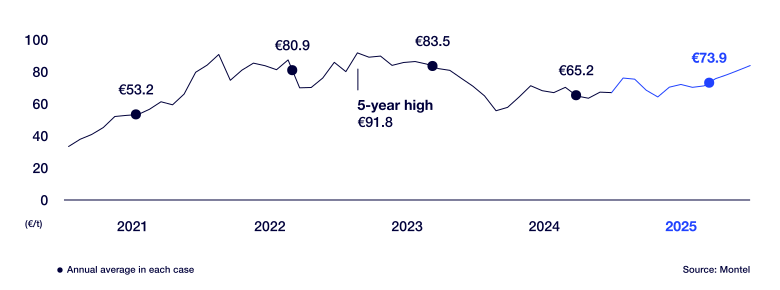
The price of CO2 rose strongly in the first quarter, but then fell again sharply in line with the US tariff momentum. As the year progressed, it returned to the Q1 level and closed the year at around €85 per metric ton. The regulatory shortage of CO2 certificates in the medium term served to stabilize the trend despite low levels of demand from electricity generation and industry.
WACKER’s energy costs dropped significantly in 2025 despite broadly flat spot market prices. Firstly, this was the result of rolling contractual coverage, which meant that lower prior-year market prices did not affect WACKER until 2025. Secondly, energy costs also fell because electricity consumption was lower due to reduced production volumes.
Market-price trends for energy sources relevant to WACKER
Traded electricity price in Germany
(EEX German Day Ahead) (€/MWh)
CO2/EUA
(€/t) (EEX Spot)
Brent crude
(€/bbl) (ICE front month)