
Research and Development
WACKER’s research and development (R&D) activities pursue three goals:
We contribute to our customers’ market success by searching for solutions that meet their needs.
We optimize our methods and processes in order to remain a technology leader and to operate sustainably.
We concentrate on creating innovative products and applications for new markets and on serving highly promising fields, such as energy storage, renewable energy generation, electromobility, modern construction and biotechnology.
WACKER’s R&D ratio – research and development spending as a percentage of Group sales – was 3.9 percent, which was above the previous year (2024: 3.6 percent). R&D spending was up year over year.
€ million |
|
2025 |
|
2024 |
|
2023 |
|
2022 |
|
2021 |
|---|---|---|---|---|---|---|---|---|---|---|
|
|
|
|
|
|
|
|
|
|
|
Research and development costs |
|
214.6 |
|
203.7 |
|
184.1 |
|
178.4 |
|
164.2 |
Our portfolio contains about 3,400 active patents worldwide, with 1,200 patent applications currently pending. We license only a small amount of know-how from third parties. In our research partnerships with entities such as universities, our policy is to ensure that the results are made available to us by transfer of rights of use.
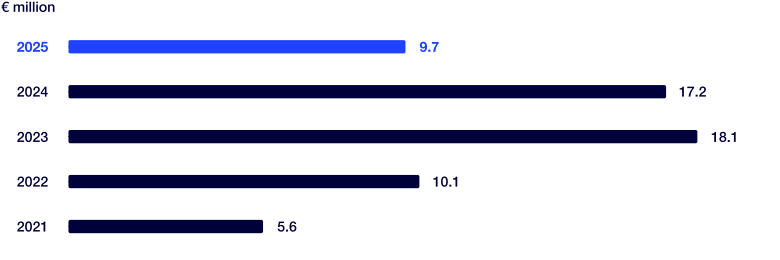
WACKER invested €9.7 million in R&D facilities in 2025 (2024: €17.2 million). We have invested in laboratories and equipment, as well as in pilot reactor technologies and pilot plants. A gas atomizer was installed and optimized at the Burghausen site. The Polymers division invested in lab automation. Corporate R&D invested in a new Biotechnology Center located on the premises of its Munich-based research facility (Consortium für elektrochemische Industrie). New fermentation capacities and systems were created in the Consortium’s pilot plant, some of which were specifically earmarked for the Food pilot plant. Investments were made in order to set up new silane labs.
Investments in R&D facilities
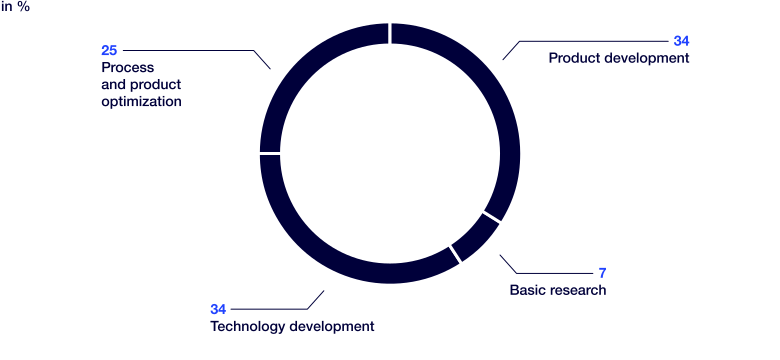
WACKER is active in many promising fields, especially medicine and biotechnology, energy, electronics, automotive, consumer care, nutrition and construction applications. We devote particular attention to efficient energy utilization, energy storage and renewable-energy generation. We closely examine the use of renewable raw materials and carbon dioxide in our value chain. Research into products and production methods accounted for a large share of R&D expenses.
Breakdown of R&D expenditures
Research and development at two levels
WACKER conducts R&D at two levels: centrally at our Corporate Research & Development department (Corporate R&D) and locally at our business divisions, where the focus is on specific applications. Corporate R&D coordinates activities on a company-wide basis and involves other departments.
Collaboration with customers and research institutes
We collaborate with customers, scientific institutes and universities to achieve research successes more quickly and efficiently. These partnerships cover topics such as CO2 electrolysis, construction applications, chemical modeling, biocatalysts, nucleic acid research and biodegradability.
Wacker Chemie AG and the Technical University of Munich (TUM) have deepened their partnership with the founding of the TUM WACKER Institute for Industrial Biotechnology. The aim is to ensure that research in the field of industrial biotechnology in Germany is conducted at the highest international level. The two partners intend to find new manufacturing approaches for pharmaceuticals, food and chemicals, where renewable resources are the basis for sustainable business management. WACKER has been funding the Institute’s research since 2022. It is providing more than €6 million under a six-year contract.
Research work at WACKER
In 2025, the Group had 919 R&D staff (2024: 956), accounting for 5.6 percent of the workforce (2024: 5.7 percent). Of these, 676 were employed at R&D units in Germany and 243 abroad.
Alexander Wacker Innovation Award
The Alexander Wacker Innovation Award, a €10,000 prize, has been conferred by WACKER for outstanding research since 2006. In the year under review, it was presented in two categories for the first time ever: Business Success and Scientific Excellence. The Business Success category saw a team from Burghausen design and use a digital twin for “Etching Line Next,” thus contributing significantly to the rapid commercial startup of the site’s production line for ultrapure semiconductor-grade polysilicon. The Scientific Excellence category was won by a team from Norway and Germany with an in-house development: an infrared camera combined with artificial intelligence that enables a look into the world’s largest silicon furnace for the first time ever in Holla, Norway.
Corporate R&D topics
Our work in Corporate R&D focuses on projects that advance sustainability topics, such as the circular economy, the biodegradability of polymers, electrolysis techniques and chemical recycling. WACKER is researching the use of sustainable raw materials to continuously reduce our products’ carbon footprint. One key aspect of the Group’s activities is biotechnology, where we are increasingly automating and digitalizing our work. In fermentation, WACKER collects extensive process data for the computer-assisted simulation and optimization of production methods. In microbiology, we have prioritized two areas. One of these is to develop and improve technologies for the production of proteins and nucleic acids (DNA, pDNA) for the pharmaceutical sector. The other is researching production systems that use fermentation and biotransformation for new food ingredients, for example, to make cell-based meat (cultivated meat) and human-milk oligosaccharides.
WACKER is also focusing on the topics of digitalization and automation. One of two projects funded by the Federal Ministry for Economic Affairs and Energy aims to use a digital product passport model to create an interoperable shared data room for chemicals and materials that enables data to be exchanged extensively along the entire chemical-industry value chain (Chem-X). The second project (RoX – a digital ecosystem for AI-based robotics and part of the EU’s “Important Projects of Common European Interest program for Next Generation Cloud Infrastructure and Services (IPCEI CIS))” – involves advancing a digital ecosystem capable of facilitating or enabling the use of innovative AI-based robotic solutions in different practical applications and industries.
Divisional research projects
At the Silicones division, sustainability is steadily taking center stage. WACKER replaces solvents with harmless, degradable products or avoids them completely, focusing on aqueous systems. We increasingly use renewable raw materials and are working on alternatives to fluorocarbons in coatings, textile applications and release agents. We are working on recycling silicones by hydrothermal degradation or acidolysis and are further developing our silicone resins for extremely durable and resistant, advanced materials. In the field of carbon capturing, an ongoing priority is the use of silica-based molded parts to separate carbon dioxide from off-gases. In cosmetics and hair conditioners, we are increasingly using degradable formulation components. Continuous advances in Silicones’ product portfolio are reducing cyclosiloxane content to a minimum. We aim to design formulations faster and more efficiently by using machine learning and artificial intelligence. We are combining silicone chemistry with new technologies, such as flow chemistry, electron radiation, high-pressure homogenization and gas atomization. For the electronics and automotive industries, we are developing new types of advanced fillers and binder concepts for regulating the temperatures of electronic components and batteries. For the medical industry, we are developing adhesives that are based on a combination of silicones and organic polymers.
At Polymers, the R&D focus is on sustainable and functional polymer binders for construction applications and for producing consumer goods. We continually review and optimize our product range on the basis of sustainability criteria. We focus on using renewable raw materials in our production processes and on reducing our carbon footprint. We develop solutions for the circular economy, including binders with a high percentage of renewable raw materials, and technologies that enable the processing and recycling of our customers’ products. Examples in the reporting period included problem-solving approaches to improve the circularity of carpets that enable highly pure carpet fibers to be separated for downstream recycling processes. We also continue to focus on constant optimization and on introducing new functionalized polymer dispersions, dispersible polymer powders, resins, sustainable binders for adhesives, and cement-based construction materials. Our aim here is to enhance our product and production technologies to save energy not only in our own processes, but also in those of our customers and to become more efficient.
The Biosolutions division continues to strengthen its biotech expertise in biopharmaceuticals and foodstuffs. In the year under review, we opened a new R&D center for biotechnology in Munich. This center serves to provide significant support for research in this field. We offer our customers microbial technologies to produce various categories of pharmaceutical proteins and for advanced nucleic acid-based therapies, including plasmid DNA (pDNA), mRNA and LNPs. In doing so, we support our partners from preclinical development right up to commercial production in compliance with GMP quality guidelines. The custom research services we launched in the reporting period are another example of our extended biopharmaceuticals range. They enable us to specifically support our customers in preclinical development phases quickly and flexibly in their product and process development. In the food sector, Biosolutions continues to focus on fermentation methods for producing high-quality, bio-based ingredients. We offer customers in the food and cosmetic sectors sustainable petrochemical-free amino acids, vitamins, saccharides, flavorings and aromas. In the reporting period, we also commercialized human-milk oligosaccharides (HMOs) for early-life nutrition. Specific media components essential for the production of alternative proteins were commercialized as well. At our León site, we implement our own and customers’ production processes on an industrial scale and in line with the required quality regimes. In cyclodextrins, we are collaborating with partners to develop applications for the food, agricultural and pharmaceutical sectors.
In order to exploit the potential of modern microchips, the semiconductor industry needs ultrapure polysilicon. Polysilicon has initiated several projects to this end, among them our new etching facility “Etching Line Next” for cleaning semiconductor-grade polysilicon in Burghausen. Construction of this facility is being funded by the European Union, the German government and the State of Bavaria. Initial quantities started to be shipped out to customers in 2025. We stepped up the Quality LeaP (Quality Leadership in Polysilicon) project to expand quality control. The type of pure polysilicon to be produced will also enable the production of chips with a design rule of 3 nm and smaller for computer applications in the field of artificial intelligence, for data centers and for autonomous driving. Only a few companies other than WACKER are capable of manufacturing such hyperpure semiconductor-grade products.